
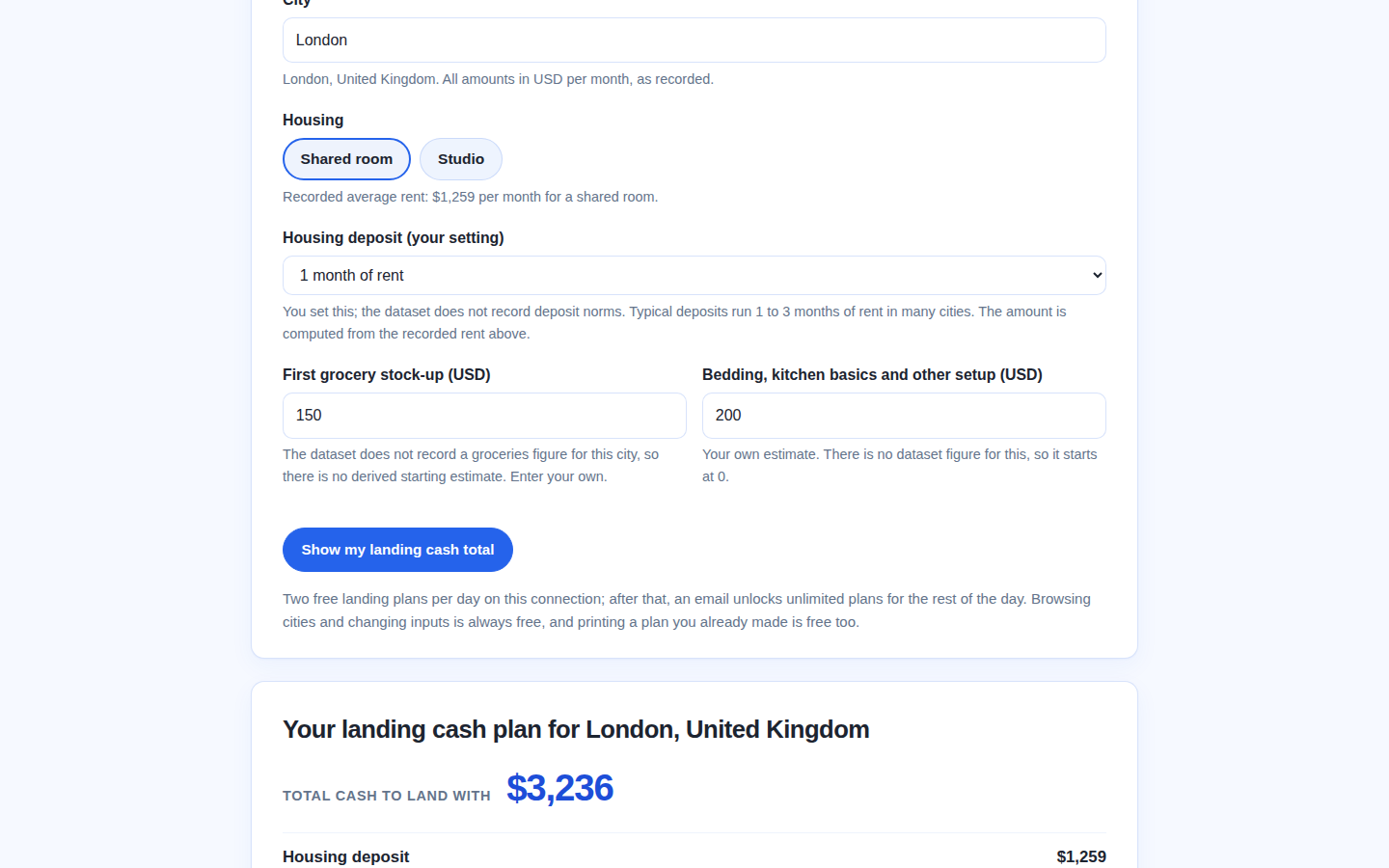
Here is a real plan, run in the free First-Month Landing Cash Planner. City: London. Housing: shared room. Deposit setting: one month. Grocery stock-up: $150, my own entry. Setup: $200, my own estimate. The plan came back at $3,236 total cash to land with.
The lines underneath matter more than the total. Housing deposit $1,259, computed from the recorded average shared room rent of $1,259. First month rent $1,259. First month utilities $368, the recorded average. Then my two own entries, $150 and $200, clearly mine because the dataset records no grocery or setup figure for London or anywhere else. After month one, a normal month runs about $1,627 on the recorded figures. Six ways to use numbers like these:
1. Size the deposit before you sign anything
The deposit is the swing line of any landing. At one month it is $1,259 in London; at the three months many landlords ask for, the same plan jumps by $2,518. Flip the deposit setting in the First-Month Landing Cash Planner before you fall for a listing, not after.
2. Compare two cities on identical lines
Same housing type, same deposit setting, same own entries: now two cities are honestly comparable, because every recorded line comes from the same dataset. That is the method behind our guide on how to compare student housing prices across different cities, and the planner is the fast version of it.
3. Price the shared room versus studio gap
Both rents are recorded for all 200 cities, so the upgrade cost is a real number, not a vibe. In city after city the studio premium over a year dwarfs the deposit difference people agonise over.
4. Notice what the tool refuses to count
Groceries are recorded for 0 of 200 cities. Transit and insurance too. The planner leaves those lines to you rather than inventing them, which is why it should sit next to a full monthly breakdown like our monthly budget breakdown, not replace it.
5. Keep landing cash separate from visa funds
Money you must show for a visa and money you actually spend on landing are different piles. The UK's official student visa money page states the evidence requirement; the planner sizes the spending pile. Confusing the two is how students land short.
6. Print the plan for the family conversation
Printing is free and the plan is line by line, which makes the funding conversation concrete: this much for the deposit, this much for month one, this much is our own estimate. If the gap needs funding, start with the ScholarshipMatch tool, and if you are earlier in the journey, the 8-Week Score Sprint Planner works backwards from test day. New to the planner itself? The short explainer covers what it counts and what it refuses to.